
What Is GEO? The New SEO Nobody Taught You
Google is no longer the only place people search. ChatGPT, Perplexity, and AI Overviews are answering questions — without sending people to your website. GEO is how you fix that. Here’s exactly what it is and how to use it.
- June 16, 2026
- Nasheetha Haznath
- 9 Min Read
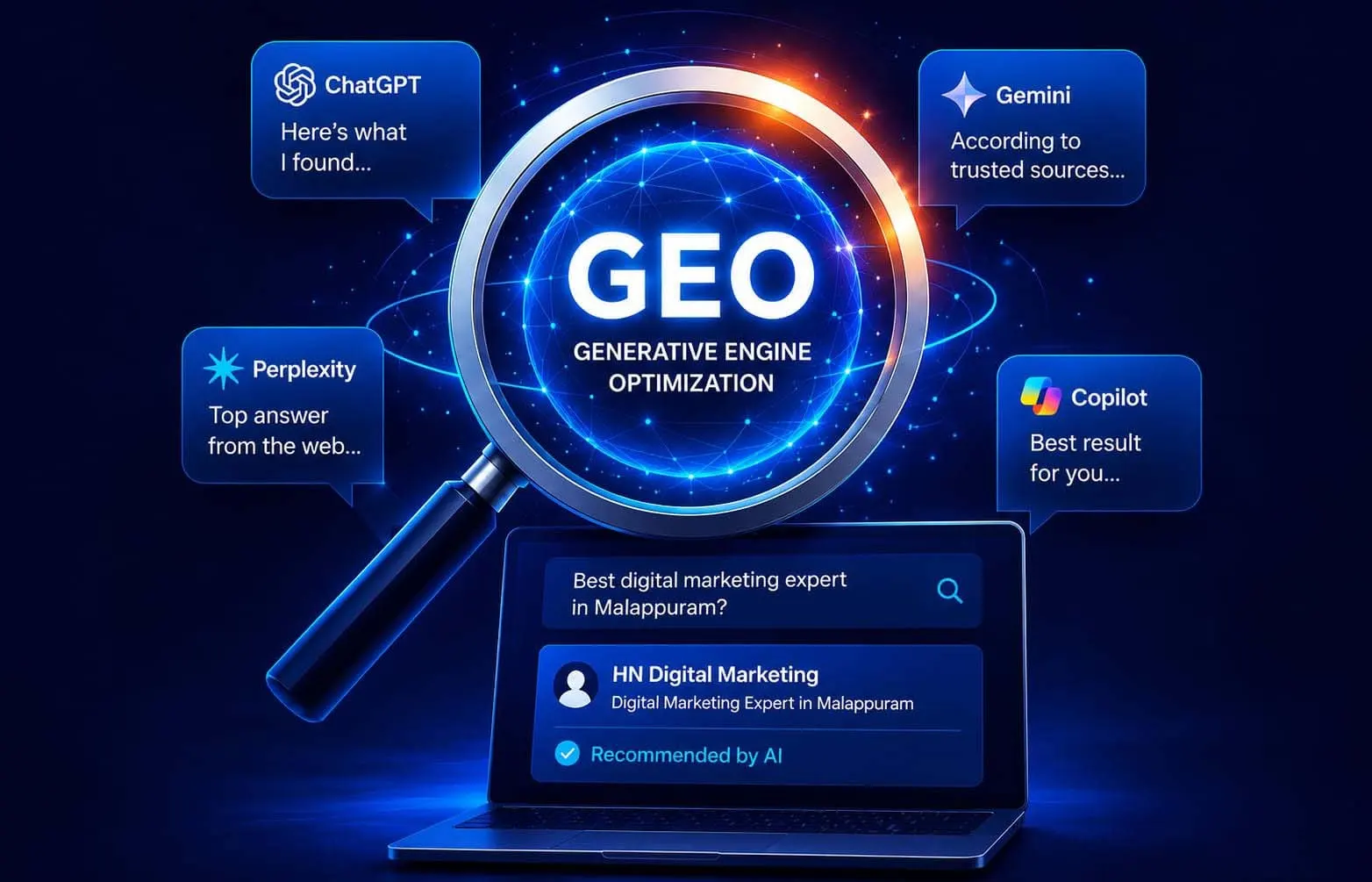
Quick Answer — What Is GEO?
GEO (Generative Engine Optimisation) is the process of making your website’s content so clear, credible, and well-structured that AI tools like ChatGPT, Perplexity, Google AI Overviews, and Gemini cite YOUR brand when answering questions — instead of someone else’s.
Let me ask you something.
When was the last time you searched for something on Google and actually clicked on a website? If you’re like most people in 2026, you probably just read the AI-generated answer at the top of the page and moved on. No click. No website visit.
Now flip that around. What if someone typed “best digital marketer in Malappuram” into ChatGPT — and the AI answered with someone else’s name? Your competitor. Not you. Even though you are better, more experienced, and more qualified.
That is exactly what is happening to businesses every single day. And that is precisely why GEO exists.
GEO stands for Generative Engine Optimisation.
It was first introduced by researchers at Princeton University, Georgia Tech, and IIT Delhi in 2023 — and by 2026, it has become one of the most important concepts in all of digital marketing.
Traditional SEO puts your website in a list of blue links that users can choose to click. GEO gets your brand cited directly inside the AI’s response — like a recommendation from a trusted expert — before the user ever sees a list of links.
If traditional SEO was about earning a spot among 10 blue links, GEO is about earning a place among the 2 to 7 domains that AI tools typically cite in a single response. The competition is tougher — but the payoff is huge: when an AI names your brand in its answer, it delivers an implicit endorsement no organic listing ever could.
Why GEO Matters Right Now in 2026
Here is what has changed in the last two years — and why you need to pay attention right now:
In 2026, with over 60% of all search interactions now involving an AI-generated component, GEO has become the single most important digital marketing discipline for any business that wants to remain visible online.
- Real Example
Someone in Dubai types into ChatGPT: “Who is the best freelance digital marketer for small businesses in Kerala?” ChatGPT reads thousands of websites, picks the most credible ones, and gives a direct answer. If your website is not structured for GEO — your name doesn’t appear. If it is? You get a direct AI recommendation to a potential client. That is the power of GEO.
SEO vs GEO — What's the Difference?
They are not enemies. They are teammates. But they work differently, target different platforms, and need different content approaches.
| FACTOR | TRADITIONAL SEO | GEO (NEW LAYER) |
| Goal | Rank in Google’s blue links | Get cited inside AI answers |
| Platforms | Google, Bing | ChatGPT, Perplexity, Gemini, Google AI Overviews |
| Result | User clicks your website link | AI recommends your brand directly |
| Content style | Keyword optimised | Citation-worthy, expert, data-rich |
| Trust signal | Backlinks, domain authority | Credibility, original data, expert voice |
| Speed of results | 3–6 months | Can appear within weeks |
Is it replacing SEO? ❌ No — GEO is an additional layer ON TOP of SEO. You need both.
- Important
GEO is not a replacement for SEO — it is an additional layer. Brands that excel at GEO in 2026 are typically the same brands with strong traditional SEO foundations. Do your SEO first, then add GEO on top. They work together, not against each other.
Where Does GEO Work?
GEO is about getting cited by AI platforms. Here are the main ones your business should care about in 2026:
ChatGPT (OpenAI)
The most widely used AI tool in the world. When users ask ChatGPT for recommendations, comparisons, or expert opinions — GEO determines whether your brand gets mentioned.
Perplexity AI
An AI-powered search engine that cites sources directly. It reads your website in real time and decides if your content is credible enough to quote. GEO-optimised pages get cited here frequently.
Google AI Overviews
The AI summary Google now shows at the very top of search results — before any website links. Being cited in a Google AI Overview gives you more visibility than ranking #1 in traditional results.
Google Gemini
Google's own AI assistant. As Gemini integrates deeper into Google Search and Android in 2026, GEO visibility here becomes increasingly important for businesses targeting mobile users.
How to Do GEO — 6 Simple Steps
GEO doesn’t require starting from scratch. It builds on existing SEO best practices and enriches them with specific techniques — extractable structure, information density, authoritative quotations, and original expertise. Here’s exactly what to do:
Answer the Question in Your First 200 Words
AI tools read the beginning of your page first. The first 200 words of any article should directly and completely answer the primary query — not build up to the answer. Don't keep readers waiting. Give the answer immediately, then explain it in detail.
Use Real Data and Specific Statistics
AI tools love citing specific numbers. Instead of writing "many businesses use Meta Ads", write "according to Meta's 2026 business report, over 10 million businesses advertise on Facebook every month." Princeton's foundational GEO study found that including statistics improved AI citation rates by 32%. Back everything up with real data.
Write in Clear Q&A Format
Structure your content with clear questions as headings and direct answers below. Use H2 and H3 headings that match exactly what people ask AI tools. "What is GEO?" "How does GEO work?" "Is GEO better than SEO?" — these headings get extracted and cited directly.
Build Real Expertise and Authority
AI tools cite sources they trust. Write from genuine first-hand experience. Share real case studies, actual results from your campaigns, specific client examples. Including expert quotations improved AI citation rates by 41% in the Princeton GEO study — the highest single improvement of any tested technique.
Add Schema Markup to Your Pages
Schema markup is code that tells AI tools and search engines exactly what your content is about. Use FAQ schema for Q&A sections, Article schema for blog posts, LocalBusiness schema for your business details. Rank Math (free) makes this very easy on WordPress — no coding needed.
Get Mentioned on Other Websites
AI tools trust brands that other credible websites talk about. Guest posts, PR mentions, directory listings, and client testimonials on third-party platforms all increase your "brand entity" — making AI more likely to recommend you. GEO visibility can be lifted by up to 40% using these research-backed citation strategies.
Should Your Business Care About GEO?
“GEO in 2026 is no longer optional — it is an operational reality. Businesses that optimise their content now to be cited by AI are building a cumulative and sustainable competitive advantage.”
— Search Engine Land, February 2026
If you run a business — whether it’s a preschool in Malappuram, a shop in Kozhikode, a freelance service in Kerala, or a brand targeting Gulf customers — people are already asking AI tools about your category. The question is: whose name comes up?
Final Thoughts
Don't Fear AI — Lead with Your Humanity
- 47% of brands have zero GEO strategy — that’s your competitive gap to fill right now
- Being cited in AI answers is like a personal recommendation from a trusted expert to your ideal client
- GEO builds on your existing SEO — you don’t start from zero, you just add a new layer
- The Princeton study proved GEO strategies can boost AI visibility by up to 40%
- The earlier you start, the harder it is for competitors to catch up