
AI vs Human
Creativity:
What the Future
Holds
Can AI really replace human creativity? A landmark 2026 study of 100,000 people reveals a surprising answer — and what it means for every marketer, creator, and business owner.
- June 5, 2026
- Nasheetha Haznath
- 8 Min Read
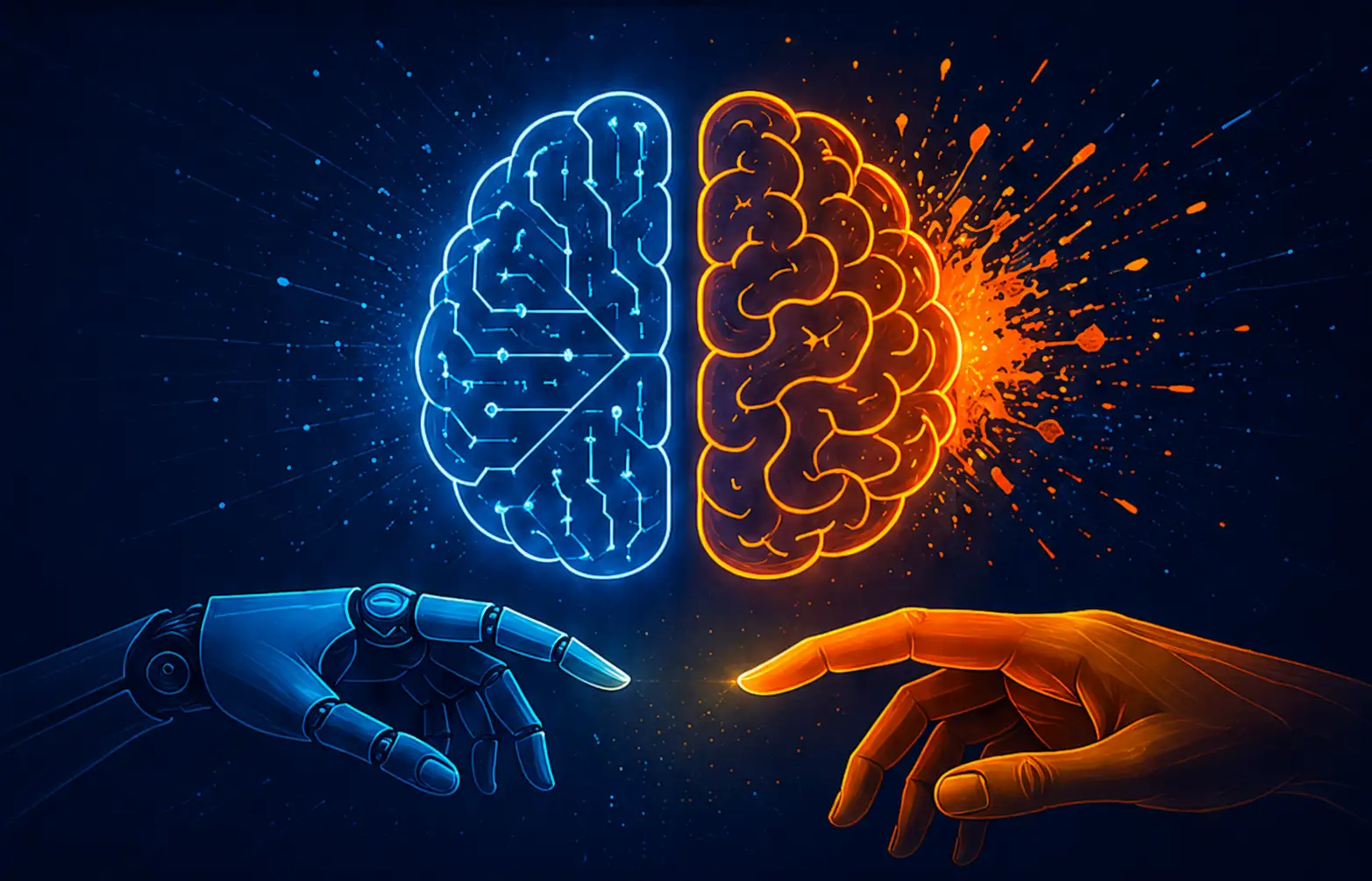
Imagine asking a robot to write a poem that makes you cry. Or designing a logo that tells your brand’s 10-year story in a single glance. Can a machine truly feel what your audience feels? That’s the question everyone in the creative and marketing world is asking right now — and in 2026, we finally have real data to answer it.
What the Latest Research Says (2026)
Here’s where it gets really interesting. A landmark study published in Scientific Reports on January 21, 2026, led by Professor Karim Jerbi of the Université de Montréal — and co-authored by AI pioneer Yoshua Bengio of Google DeepMind — tested more than 100,000 people against today’s most advanced AI systems, including GPT-4, Claude, and Gemini.
The result? AI can now beat the average human on certain creativity tests. Specifically, on “divergent thinking” tasks — the ability to generate original, varied, and unexpected ideas — some AI models outperformed the typical human response.
What AI Is Really Good At
Let’s be honest — AI is genuinely impressive at certain creative tasks. Here’s what it excels at right now:
Speed and Volume
A campaign manager can now generate and test dozens of ad headlines or social media captions in the time it once took to brainstorm a handful. A designer can produce a full range of visual concepts shortly after a brief is discussed. Speed and scale are AI's biggest gifts to creativity.
Speed and Volume
A campaign manager can now generate and test dozens of ad headlines or social media captions in the time it once took to brainstorm a handful. A designer can produce a full range of visual concepts shortly after a brief is discussed. Speed and scale are AI's biggest gifts to creativity.
HubSpot 2026 State of Marketing Report
32.82% of marketers say AI tools are saving them 10–14 hours per week — that's almost two full working days returned to strategy, creative thinking, and client relationships.
Pattern Recognition & Data
AI is exceptional at spotting what worked before. It can analyze thousands of top-performing ads, identify patterns in design, and predict what type of content your audience is likely to engage with — all in seconds.
Removing the Blank Page Problem
One of the hardest parts of any creative job is starting. AI removes writer's block instantly. You give it a brief — it gives you 10 starting points. Then the human takes over, refines, and makes it real.
Scaling Personalisation
AI can create thousands of visual or copy variations of one campaign — each tailored to a different audience segment, language, or platform — at essentially zero extra effort. For performance marketers, this is revolutionary.
What AI Cannot Do (And Likely
Never Will)
Here’s where human creativity remains irreplaceable — and this is the most important section for every marketer, designer, and content creator to understand deeply.
Genuine Emotion & Lived Experience
AI has never felt heartbreak, joy, cultural pride, or loss. It has read about these things. There's a massive difference. The most resonant creative work — the ad that makes you cry, the post that goes viral because it's so real — comes from a human who has truly felt something.
Cultural Intuition
AI doesn't truly understand culture — it imitates it. A Kerala marketer knows that Onam content needs warmth, nostalgia, and family. That a Gulf diaspora audience values both homeland pride and aspiration. That nuance is entirely human.
True Originality
Research confirms that AI tends to repeat the same "safe" ideas. It gravitates toward what has been done before because it learns from existing data. Disruptive, industry-shifting creativity — the kind that moves culture — comes from humans.
Moral Judgement & Responsibility
Who decides if an ad is ethical? Who ensures a campaign doesn't accidentally offend a community? AI has no conscience. Human creative professionals do — and in 2026, that accountability matters more than ever.
Storytelling Depth
The 100,000-person study was clear: in creative writing tasks like poetry, storytelling, and plot development, human creators maintained a clear advantage over every AI system tested. Raw emotion, narrative arc, character depth — still deeply human territory.
Let’s be honest — AI is genuinely impressive at certain creative tasks. Here’s what it excels at right now:
It's Not AI vs Human — It's
Human + AI
Here’s the most important takeaway from everything we know in 2026:
The debate is no longer “AI vs Human Creativity.” It’s “Humans who use AI” vs “Humans who don’t.”
— Digital Marketing Insight, 2026
The creative sector has moved past the fear of replacement and into the era of Human–AI Co-Creation. The global market for generative AI in creative work has grown into a $15.6 billion industry this year — not by replacing creators, but by embedding AI as a permanent creative co-pilot.
The 70/30 Rule (Gaining Traction in 2026)
Let AI handle 30% — the repetitive, data-heavy, first-draft work. Keep humans on the 70% — the strategic, emotional, culturally-aware decisions that actually connect with real people.
As Professor Jerbi himself concluded: “Generative AI should be viewed less as a competitor and more as a creative amplifier.”
What This Means for Digital Marketers
If you’re a digital marketer — whether running a brand in Malappuram or managing campaigns for a Dubai-based business — here’s what this means practically:
Your value is your human insight. The barrier to entry has shifted. It's no longer "Do you know the software?" It's "Do you understand the customer?" That's a deeply human skill AI cannot replicate.
AI literacy is non-negotiable. 83% of creative professionals now use generative AI tools. Those who haven't adapted are already at a disadvantage. Learn the tools — don't fear them.
Your creativity is your competitive advantage. AI makes average creative work cheaper and faster. This raises the bar for truly great work. Unique perspectives and authentic voices are more valuable now than ever before.
AI handles the boring, you handle the brilliant. Use AI for first drafts, data analysis, variations, and scheduling. Use your brain for strategy, brand voice, cultural reading, and emotional connection.
Final Thoughts
Don't Fear AI — Lead with Your Humanity
If you’re a creative professional, a marketer, or a business owner reading this — take a breath. AI is a powerful tool and it will keep getting better.
But it will never replace what makes your work yours — your perspective, your empathy, your lived experience, your cultural understanding, your ability to look a client in the eye and know exactly what they need.
The most important thing you can do right now? Learn AI. Use AI. But never become AI.
Stay curious. Stay human. Stay creative. Because in a world where anyone can generate a caption in 2 seconds, the ones who will win are the ones who can make people feel something. And that — for now and for the foreseeable future — is still very much a human superpower.